
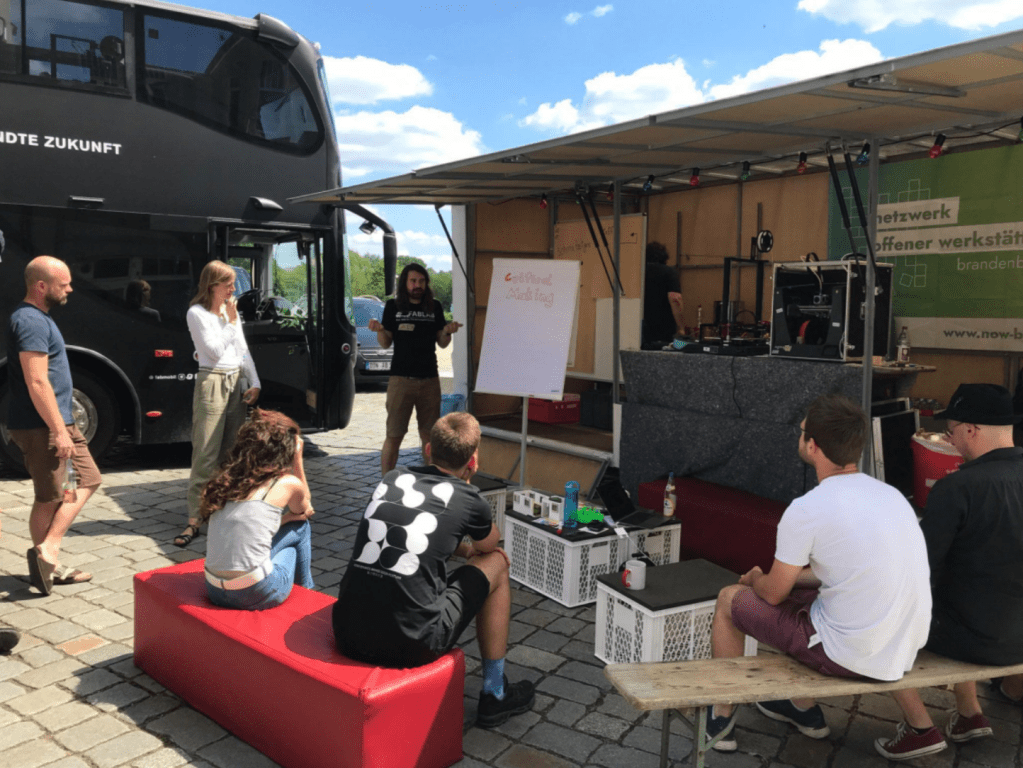
Network meeting of mobile FabLabs, Brandenburg
During this community meeting, we had the chance of hosting a dedicated session on Critical Making. We first grounded the session with a brief explanation about the Critical Making programme, and then started a discussion. Participants were mainly educators who were already familiar with concepts related to Critical Making. We posed the question:
“Why is (critical) making not widespread in schools (yet)?”.
The collective answer was simply an overarching “lack of openness” on various levels of the educational system in Germany.
We then proceeded to collect input on what is important to allow for Critical Making in schools. In the following, we list the responses as translated into top-level concepts and their supporting points gathered:
Start where the people are
- Start from where the people are and go from there
- Assume less, approach people openly
- Check the status quo
- Fun & learning
Support and Mentoring
- Supporting through communication: especially important in the beginning, but also throughout the process
- Accompaniment is essential
- Social component of Critical Making
- Asking questions to stimulate brainstorming
Reflexivity
- Explore different approaches
- Make transparent on which levels one can think
- Adopt different points of view
- Expand imagination and awareness
- Understanding
- Perspectives
Critical Making
- Materials and machines used are important
- Finding adequate technologies (together)
Self understanding of the participating educators
- We are not service providers
- We solve problems
- We are facilitators
- We have to be critical ourselves
This article describes our encounters and findings from a series of workshops that were designed to explore ways to integrate Critical Making within the educational system as part of the project’s participatory action research methodology.
Keen to learn more? Read about our team’s encounter at a Kids and Caretaker Workshop at the GoodLab, Berlin.
 Critical Making